

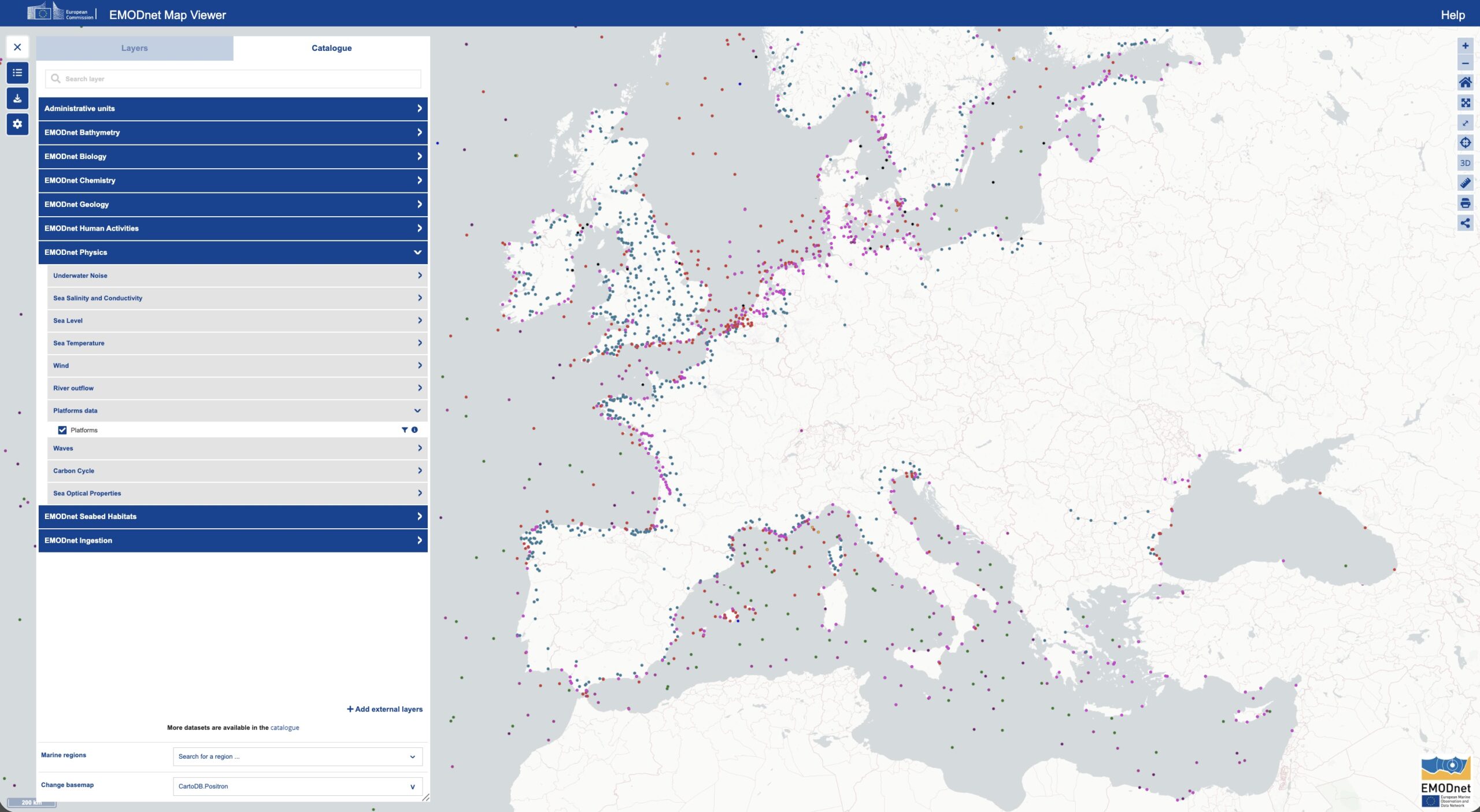
EMODnet Physics
Europe’s approach to ocean knowledge is undergoing a fundamental transformation. Driven by the convergence of the EMODnet Vision 2035, the European Ocean Pact, and the emerging European Digital Twin Ocean (EDITO), the continent is building a marine data ecosystem where observations, infrastructures, and digital modelling capabilities operate as a single, seamless whole.
At the centre of this transformation stands EMODnet Physics — the thematic component of the European Marine Observation and Data Network dedicated to physical oceanography.
"EMODnet Physics has evolved from a European data aggregation initiative into a globally connected, operational, and policy-relevant marine data infrastructure." (A. Novellino coordinator of EMODnet Physics)
What Is EMODnet Physics?
EMODnet (European Marine Observation and Data Network) is a long-term initiative of the European Commission’s DG MARE, structured around seven thematic domains: bathymetry, biology, chemistry, geology, human activities, physics, and seabed habitats. EMODnet Physics is the domain dedicated to physical oceanographic parameters.
It covers a broad suite of Essential Ocean Variables (EOVs): temperature and salinity profiles, sea surface currents, sea level trends, wave height and period, wind speed and direction, water turbidity, underwater noise, river flow, and sea-ice coverage. Data originate from fixed platforms (moorings, tide gauges, HF radars), moving platforms (Argo floats, Lagrangian buoys, ferryboxes), and repeated observation campaigns (CTD casts). All services are provided free of charge and without restrictions.
~600 Institutes & data providers federated across Europe and beyond

100k+ Datasets linked and served from a single access point

7 Successive project phases since the Preparatory Action in 2010
A Two-Decade Journey
EMODnet Physics traces its origins to the core EU design principle — “collect once and use many times” — that has guided its federated, non-duplicative architecture from the outset.
Rather than operating its own observing systems, EMODnet Physics functions as a data integration and dissemination layer, aggregating and harmonising data collected by national, European, and international initiatives. It interoperates with major European infrastructures (Copernicus Marine Service INSTAC, SeaDataNet, ICES) and global programmes (Argo, OceanSITES, GO-SHIP, GLOSS, DBCP), effectively bridging the gap between distributed observation networks and end users across the research, policy, and blue-economy communities.
This continuity has been anchored by consistent scientific leadership. Since the very first phase in 2011, EMODnet Physics has been coordinated by Antonio Novellino (ETT S.p.A., Genova) and Patrick Gorringe (formerly SMHI, now CMCC) — a partnership that has steered the initiative through every project phase and shaped its evolution from a regional data pilot into a globally connected marine intelligence service.
The Observing Platform Ecosystem
EMODnet Physics draws from one of the most diverse platform ecosystems in operational oceanography. Each platform type brings unique strengths and limitations:
- Fixed stations & moorings — long-term continuous measurements at key locations, providing the temporal backbone for trend analysis.
- Argo profiling floats — approximately 4,000 floats cycling every 10 days, the primary global source of temperature and salinity profiles to 2,000 m depth and beyond.
- HF Radar networks — the EMODnet Physics HF Radar catalogue comprises ~290 antennas, making it one of the most comprehensive surface current observation networks worldwide.
- Tide gauges — over 500 EuroGOOS stations plus 1,250+ UNESCO IOC gauges feeding global tsunami warning networks and the PSMSL global sea-level database (~2,350 stations).
- Gliders & profiling floats — high-resolution transects of physical and biogeochemical parameters, complementing fixed moorings in dynamic boundary regions.
- Ships of opportunity & FerryBoxes — continuous surface observations of temperature, salinity, turbidity, chlorophyll, and dissolved gases along commercial shipping routes.
- Instrumented marine mammals — tags on seals and other animals providing temperature/salinity transects in high-latitude and ice-covered regions inaccessible to conventional platforms.
- River stations — thousands of coastal gauging stations interoperable with WMO WHOS and GRDC, quantifying freshwater inputs that drive stratification, upwelling, and coastal circulation.
"By promoting harmonisation and common standards, EMODnet Physics bridges local, regional, and international marine data communities — transforming raw ocean data into actionable knowledge."
Supporting European Marine Policy
EMODnet Physics is not merely a scientific infrastructure — it is a policy instrument. Its datasets directly underpin several major EU legislative frameworks:
Water Framework Directive (WFD, 2000/60/EC)
River discharge, temperature, salinity, and dissolved oxygen data integrated by EMODnet Physics support Member States’ assessments of the ecological and chemical status of coastal and transitional waters, including habitats for shellfish, bathing, and fish near river mouths.
Marine Strategy Framework Directive (MSFD, 2008/56/EC)
EMODnet Physics provides validated, aggregated data supporting multiple Good Environmental Status (GES) descriptors: biodiversity and habitat quality (D1), food web dynamics (D2), eutrophication from river nutrient inputs (D5), hydrographical conditions including temperature, salinity, currents, and waves (D7), and underwater noise (D11) — the latter coordinated with TG-NOISE assessments and EU threshold values.
Maritime Spatial Planning (MSP) Directive (2014/89/EU)
Harmonised, high-quality physical oceanographic datasets from EMODnet Physics inform spatial planning decisions for aquaculture, marine renewable energy, maritime transport, and the blue bioeconomy, ensuring that ecosystem-based management can draw on consistent cross-border data.
European Green Deal & Climate Action
The ocean’s role as a carbon sink and climate regulator depends on reliable, long-term records of heat content, sea level, and carbon uptake. EMODnet Physics ensures open, continuous access to these climate-critical variables, supporting decadal-to-centennial prediction efforts and ocean ventilation research.
Relevance for Biosensor and Monitoring Communities
For the AquaBioSens community — researchers and technology developers working at the intersection of aquatic biosensing, water quality monitoring, and environmental intelligence — EMODnet Physics offers several concrete entry points:
- Contextual environmental data for calibrating and interpreting biosensor outputs: temperature, salinity, oxygen, turbidity, and river discharge are all available via standard APIs.
- Co-location opportunities: the FerryBox, fixed mooring, and river station networks represent existing infrastructure with which biosensor payloads could potentially be integrated.
- FAIR data workflows as a model: the metadata standards, controlled vocabularies, and interoperability protocols adopted by EMODnet Physics provide a mature reference framework for designing data pipelines for novel biosensing deployments.
- Policy alignment: datasets supporting MSFD and water quality parameters demonstrate how sensor data pipelines can be designed from the outset to feed regulatory reporting requirements.
EMODnet Physics stands as one of the most ambitious and mature examples of federated, open, FAIR-compliant marine data infrastructure in the world. Over 15 years it has grown from a European coordination mechanism into a globally connected service supporting operational forecasting, scientific research, policy implementation, and sustainable ocean governance. As Europe moves toward EMODnet Vision 2035 and the European Digital Twin Ocean, its role as the in-situ observational backbone of Europe’s ocean knowledge system will only deepen.
For anyone working in aquatic sensing, environmental monitoring, or blue economy innovation, understanding and engaging with EMODnet Physics is not optional — it is a key action on which future ocean intelligence will be built.
Author:
Antonio Novellino
Links
Keywords
Ocean Data, FAIR, EMODnet, Monitoring, EOVs