New Bi-Directional Microfluidic Biochip System for Real-Time Monitoring of epithelial barrier
We have developed a microfluidic platform designed to mimic the physiological conditions of the epithelial cells. The core objective was to create a bi-directional flow chip that simulates the natural environment, with water flowing over the apical surface and culture media, mimicking blood, flowing through the basolateral channel.
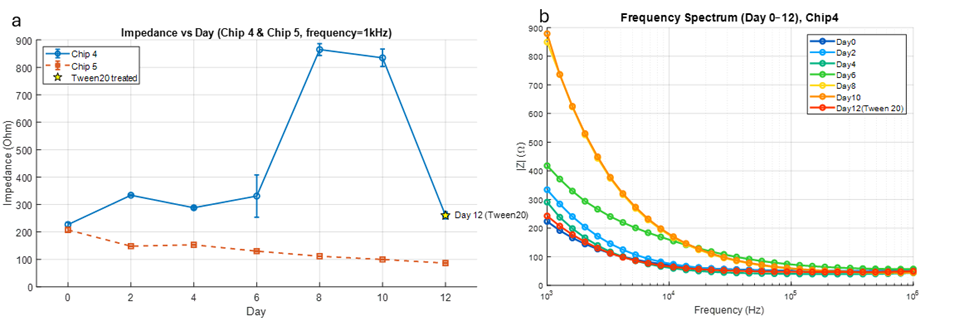
The system utilizes a modular biochip integrated with a nanoporous membrane for cell growth. To ensure stable culture conditions, the experimental setup is housed within an incubator, with fluidic connections established from a syringe pump. The platform is powered by a microcontroller with an impedance analyser, allowing automated data recording at set time intervals across a frequency range of 100 Hz to 1 MHz. The system has been prototyped and validated using human intestinal Caco-2 cells under continuous perfusion for up to 12 days.
The system successfully tracked epithelial barrier formation over time, showing a clear increase in impedance in chips containing cells compared to stable control chips. Using explants, the transepithelial electrical resistance (TER) increased by approximately 500 ohms. Disruption of the cell layer resulted in a rapid decrease in impedance. Changes at low frequencies were specifically associated with barrier formation, while stable responses at higher frequencies indicated consistent system performance.
This platform offers a scalable tool for evaluating pollutant-induced damage in aquatic species. Future phases will include testing with metal exposures and gene expression analysis.
Author: Dr Junyu Chen, University of Southampton
Keywords
bi-directional flow, fish gill, TEER, microfluidic biochip, impedance measurement, epithelial model, AquaBioSens